












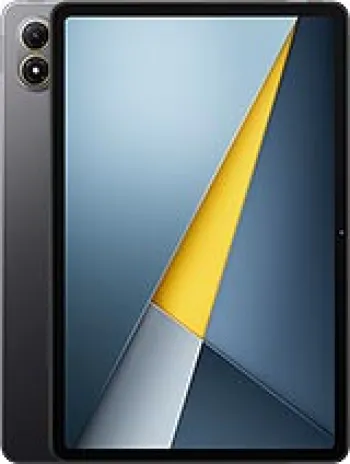
Design and Build Quality
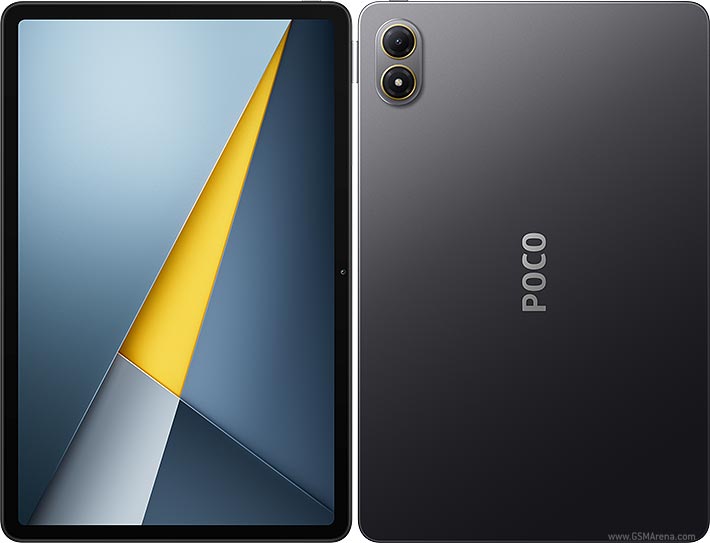
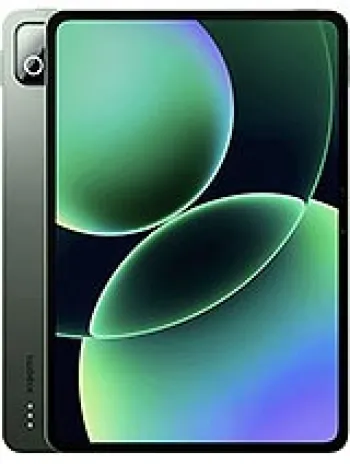
The Xiaomi Poco Pad M1 boasts a premium design with an aluminum frame and back complemented by a glass front. Its sleek dimensions measure 279.8 x 181.7 x 7.5 mm, giving it a slim profile of just 7.5 mm thickness, and it weighs 610 grams (approximately 1.34 lbs). The build quality represents a solid balance between sturdiness and style, making it both portable and attractive for users who demand a durable tablet without extra bulk.
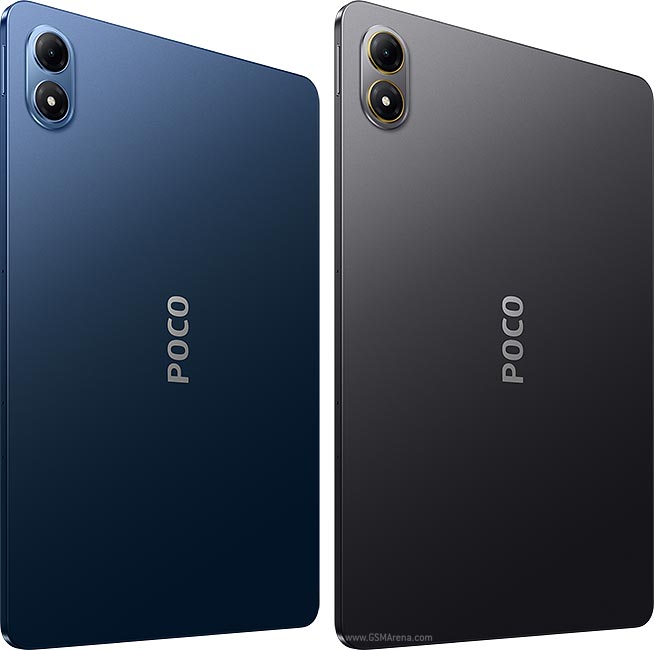
The device is available in two subtle color options: Gray and Blue, catering to users who prefer understated elegance. The aluminum chassis lends rigidity and a comfortable in-hand feel, while the glass front is protected by Mohs level 6 hardness, providing a good resistance to scratches and minor abrasions. Overall, Poco Pad M1’s construction ensures it stands up well to daily use.
Display
The Poco Pad M1 features a sizable 12.1-inch IPS LCD display, supporting 1 billion colors for rich and vibrant visuals. Its resolution is 1600 x 2560 pixels with an aspect ratio of 16:10, yielding approximately 249 pixels per inch. This makes text sharp and images detailed enough for media consumption, productivity, and gaming.
The screen supports a smooth 120Hz refresh rate, which enables fluid animations and responsiveness especially appreciated in fast-scrolling scenarios and compatible applications. Furthermore, the display includes Dolby Vision support for enhanced HDR content, delivering brighter highlights and deeper contrast, boosting the overall viewing experience.
Peak brightness reaches up to 600 nits (High Brightness Mode), allowing comfortable outdoor use under direct sunlight. The screen-to-body ratio stands at approximately 83.5%, offering a relatively immersive viewing area despite slightly larger bezels compared to some competitors.
Performance and Hardware
At the heart of the Poco Pad M1 lies the Qualcomm Snapdragon 7s Gen 4 chipset built on a 4nm process. The SoC incorporates an octa-core CPU setup with one Cortex-A720 core clocked at 2.7 GHz, three Cortex-A720 cores at 2.4 GHz, and four energy-efficient Cortex-A520 cores running at 1.8 GHz. Coupled with the Adreno 810 GPU, this configuration delivers a robust balance of power efficiency and performance for everyday tasks, multimedia, and light to medium gaming.
The device is equipped with 8GB of RAM, providing smooth multitasking capabilities and efficient app switching. Storage-wise, it offers a generous 256GB of internal flash memory, ample space for apps, files, and media. Additionally, there is a dedicated microSDXC slot for expandable storage, allowing users to further increase their capacity without sacrificing SIM compatibility or other card slots.
Software
The Poco Pad M1 runs the latest Android 15 operating system out of the box combined with Xiaomi’s proprietary HyperOS 2 skin. This combination brings an intuitive and polished user interface with smooth animations, useful custom features, and generous customization options. HyperOS 2 builds upon Android 15’s core by optimizing system performance, enhancing power management, and streamlining notifications.
The software package supports multi-window multitasking suited for a large-screen device, making the 12.1-inch canvas ideal for productivity, document editing, and media multitasking. Regular security updates and access to a broad app ecosystem via Google Play Store ensure that users keep up with the latest Android apps and features.
Camera System
The Poco Pad M1 carries a modest yet capable camera setup suitable for casual photography, video calls, and document scanning. On the rear, there is a single 8 MP wide-angle sensor with an f/2.0 aperture. The sensor size is 1/4.0” and the pixel size is 1.12µm, adequate for capturing decent daylight photos with reasonable detail and color accuracy.
The rear camera includes a Color Spectrum Sensor that helps improve white balance and color fidelity, paired with an LED flash and HDR capabilities. Video recording is limited to 1080p at 30fps, enough for standard video capturing.
On the front, the selfie camera also sports an 8 MP sensor with f/2.3 aperture, featuring similar sensor dimensions which facilitate clear and natural-looking video calls and selfies. The front camera’s video capture matches the rear at 1080p 30fps.
Connectivity and Communication
Notably, the Xiaomi Poco Pad M1 does not include cellular connectivity; it is strictly a Wi-Fi-only device. This means there is no support for 2G, 3G, or LTE mobile networks, making it suitable primarily for home, office, or hotspot usage scenarios.
For wireless communications, the tablet supports Wi-Fi 802.11 a/b/g/n/ac/6 on dual bands, enabling fast and stable internet connectivity. It also features Wi-Fi Direct for device-to-device transfers and advanced Bluetooth 5.4 support with A2DP, LE, aptX HD, and aptX Adaptive codecs for high-quality wireless audio streaming.
The tablet includes a USB Type-C 2.0 port with OTG support, allowing connection of external drives, peripherals, and accessories. However, it lacks NFC capabilities and FM radio functionality.
Audio
Audio performance on the Poco Pad M1 is emphasized with a quad-speaker setup enhanced by Dolby Atmos support, providing immersive stereo sound with clarity and balanced levels. This four-speaker configuration helps produce rich bass and spatial audio effects that elevate media consumption and gaming.
Additionally, the tablet retains a 3.5mm headphone jack, a feature increasingly rare in modern tablets, allowing easy connection of standard wired headphones or external speakers without the need for adapters.
Battery and Charging
The Poco Pad M1 is equipped with a massive 12000 mAh battery that ensures exceptional endurance. Supported charging speeds are 33W wired fast charging via USB-C, using Power Delivery 3.0 and Qualcomm Quick Charge 3+ standards, enabling relatively quick recharge times given the large capacity.
Furthermore, the tablet supports 27W reverse wired charging, allowing it to function as a power bank to charge other devices, a convenient utility in emergencies or when traveling. Xiaomi claims the battery endurance at roughly 103 hours based on their EU label testing criteria, ensuring extended usage for video playback, web browsing, or light productivity on a single charge.
Battery longevity is rated for 1000 charge cycles, signifying reliable capacity retention over years of use. The Poco Pad M1 is classified as energy class G, reflecting the substantial battery it contains to meet power-hungry demands of a large display and powerful chipset.
Sensors and Additional Features
The Poco Pad M1 includes the essential sensors to complement everyday tablet interaction and supporting accessories. These sensors include an accelerometer, gyroscope, compass, and a proximity sensor (available through accessories only). Such sensors allow for better motion detection, orientation adjustments, and location-related functionalities within apps.
The absence of GPS positioning, NFC, and cellular radios indicates its usage is mostly focused on Wi-Fi environments and offline media consumption rather than navigation or contactless payments. However, USB OTG support means users can extend functionality by connecting a wide range of peripherals.
Network and SIM
Xiaomi Poco Pad M1 is designed exclusively as a Wi-Fi-only tablet, meaning no SIM card slot or cellular network technologies are included. It does not support any 2G, 3G, or LTE bands, and therefore, it depends entirely on Wi-Fi connectivity for internet access. This setup targets users seeking large-screen tablets primarily for home, office, or educational use where Wi-Fi coverage is available.
Launch Information and Availability
The Xiaomi Poco Pad M1 was officially announced on November 26, 2025, and is already available in the market. It aims to compete directly in the mid-range tablet category, offering compelling hardware specifications typically found in higher-tier devices while keeping price competitive.
Since launch, the Poco Pad M1 has attracted users looking for a balance between productivity, entertainment, and long battery life, especially those inclined toward the Xiaomi ecosystem and Android’s latest iteration with HyperOS.
Repairability and Durability
According to EU labeling data, the Poco Pad M1 scores a Class A rating for free fall durability, capable of surviving up to 208 falls, reflecting a well-built chassis and protective design. Its repairability is rated Class C, suggesting that while it can be serviced or repaired, some internal components might be challenging to replace by end-users without professional help.
This degree of durability and repairability is above average for tablets in this segment, making the Poco Pad M1 a resilient device expected to maintain operational integrity across daily use and occasional accidents.
Summary
The Xiaomi Poco Pad M1 is a well-rounded tablet offering a large, high-quality 12.1-inch IPS LCD display with a 120 Hz refresh rate and Dolby Vision, powered by the efficient Snapdragon 7s Gen 4 chipset coupled with 8GB RAM and substantial 256GB storage expandable via microSDXC. It stands out with its significant 12000 mAh battery capacity and fast 33W charging, backed by reverse wired charging capability.
While it lacks cellular connectivity and advanced location features, the device is ideal for users looking for a premium build, vibrant viewing experience, solid daily performance, long battery life, and rich audio aided by Dolby Atmos enabled quad speakers. Its launch with Android 15 and HyperOS 2 makes it future-proof in terms of software and user experience.
Overall, the Poco Pad M1 caters to media consumers, students, and professionals requiring a dependable, portable, and powerful tablet at a competitive price point without sacrificing build quality or essential functionalities.
Key Features of Xiaomi Poco Pad M1
- Large 12.1-inch IPS LCD display with 1 billion colors, 120Hz refresh rate, Dolby Vision, and 600 nits peak brightness
- High resolution screen: 1600 x 2560 pixels with 16:10 aspect ratio and Mohs level 6 protection
- Powered by Qualcomm Snapdragon 7s Gen 4 chipset (4 nm) with Octa-core CPU and Adreno 810 GPU
- Runs on Android 15 with HyperOS 2 for latest software experience
- Generous 8GB RAM and 256GB internal storage with dedicated microSDXC card slot for expandable memory
- 8 MP main camera with color spectrum sensor, LED flash, HDR support, and 1080p video recording
- 8 MP front-facing wide camera capable of 1080p video recording
- Stereo sound system with 4 speakers supporting Dolby Atmos and 3.5mm headphone jack
- Massive 12000 mAh battery with 33W wired fast charging and 27W reverse wired charging support
- Premium build with glass front, aluminum frame, and aluminum back - slim and lightweight at 610g
- Comprehensive connectivity including dual-band Wi-Fi 6, Bluetooth 5.4 with aptX HD/Adaptive, and USB Type-C 2.0 with OTG
- Useful sensors including accelerometer, gyro, compass, and accessory proximity sensor
- Available in stylish Gray and Blue colors
Disadvantages of Xiaomi Poco Pad M1
- No cellular connectivity, limiting use to Wi-Fi only.
- Relatively low screen resolution for a 12.1-inch display (249 ppi).
- No NFC support, affecting contactless payments and quick device pairing.
- No positioning system (GPS), which limits navigation and location-based services.
- USB Type-C 2.0 port instead of the faster USB 3.x standard.
- Average main and selfie cameras (both 8 MP) with basic video capabilities (1080p@30fps).
- IPS LCD display offers lower contrast and viewing angles compared to OLED panels.
- Display protection rated only at Mohs level 6, less durable against scratches.
- Heavy weight at 610 grams, less portable compared to some competitors.
- Energy efficiency rated Class G, indicating higher power consumption.
- Repairability rated Class C, suggesting moderate difficulty and cost for repairs.
- Absence of FM radio.

View Also
More Phones





All Rights Reserved +14300 Phones © Mobilawy 2025